


edited/compiled by R. Venkatesan, Bengaluru
Review: Prof Shankar Chatterjee
I have gone through the book mentioned above, edited by an erudite scholarly person, R. Venkatesan (presently 87 years old), settled in Bengaluru. There are altogether 21 chapters spread over 347 pages, excluding pages containing photographs, the preface, and other supplementary materials. So, I appreciate the author for editing 347 pages about the ancient wisdom and science of Mahasomayaga. The gist of the chapters is presented here for the readers’ benefit.

Chapter 1, ‘Shodasi Somayaga’ (written by Srinivas Sattri, Adhvaryu), briefly explains the various rituals, sets of rules, and regulations that need to be followed on all days, as well as the significance, roles, and responsibilities of the team members in performing the yaga as prescribed in the Vedas. Chapter 2, titled ‘Scientific Study of Somayaga Yadnya’ by Abhang Pranay, mentions that Somayaga Yadnya is a ritual of offerings accompanied by chanting of Vedic mantras derived from the practice in Vedic times. Yagnya fumes and the overall process affect environmental elements; hence, their effects on oxides of sulfur and nitrogen were studied, as they are the major air pollutants. Chapter 3, ‘Electro Photonic Imaging Based Study of Agnistoma Somayaga’ by Divya B. R. (et al.), has highlighted that Electro Photonic Imaging (EPI) was used to capture for 6 days before, during, and after the practice of the Yaga Performance. The study suggests that the Somayaga has a profound effect on the health of the individual performing the Yaga. Chapter 4, ‘Investigation of random event generator changes in Agnistoma Somayaga rituals: An exploratory study’ by Divya B. R. and others, has revealed that spiritual rituals and Vedic Yagas affect and influence the way people live, which spreads harmony and peace. The title of Chapter 5, ‘Atiratra Somayaga 2015,’ reveals that the beneficial effect of each Homas lasts for several decades. Chapter 6 deals with ‘Somayaga Influences on Different Parameters of Narmada River,’ written by Shailedra Sharma and others. The overall work concluded that the Somayaga performed has a positive effect on improving the quality of water. In Chapter 8, ‘Scientists Say Ancient Fire Ritual ―Athirathram‖,’ the Yaga seems to have accelerated the process of seed germination. The performance of Yaga helps in cleaning the environment of specific pollutants, as described in Chapter 9 on ‘Effect of Bhaishajya Maha Yajna on Human Energy Field and Environment, written by Sushrutha and others.
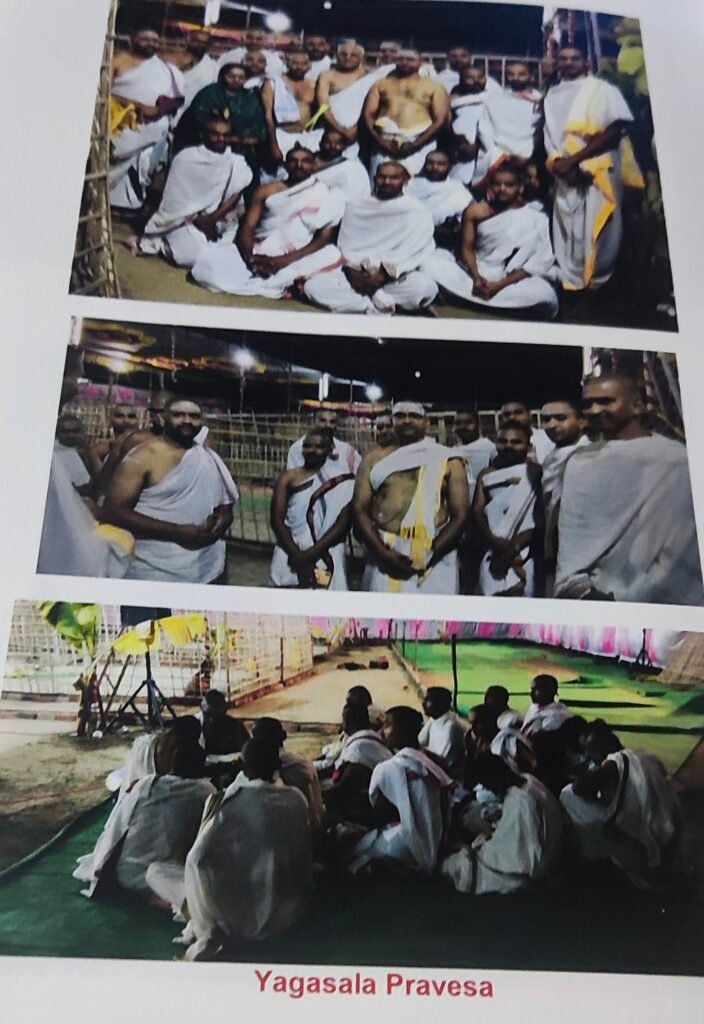
The title of Chapter 10, ‘References in Vedas in confirmation of all the claims about HOMA’ by Subodh Kumar, clarifies the content. The various aspects of performing the Yaga and construction of Yagashala (Yaga’s place) have been discussed in Chapter 11, titled ’An Introduction to Mahasomayaga and Vedic Yagas in General,’ written by R.S. Alvar and others. Chapter 12 is titled ‘The report from studies in India’ by Dr. Wojciech Puchalski, which describes some preliminary results of studies on the energetic and environmental effects of Vedic rituals and ceremonies, including Somayaga, Agnihotra, and others. In Chapter 13, under the title of “Science of Yajna—Environmental Effects Results of Some Recent Experiments,” a group of scientists led by Dr. Manoj Garg, an environmentalist, proved that carbon monoxide came down to zero after the Yaga. Chapter 14, titled “The Integrated Science of Yagna” by Pt. Shriram Sharma Acharya, is a compilation of details on the science of yagnas. ‘Homa Therapy and its impact in mitigating environment, soil, and water crises: A researchable issue,’ written by Prof. R.K. Pathak and Dr. Ulrich Berk, is the essence of chapter 15. Chapter 16, ‘Physiological Effects of Mantras on Mind and Body,’ by Dr. W. Selvamurthy and others. The study has illustrated some of the positive influences of mantras recited during Agnihotra on the mind and body. ‘New Research on the Beneficial Effects of Agnihotra on Brain Waves’ is the focus of Chapter 17. Chapter 18, ‘Sacrificially Important Trees Revealed in the Krsna Yajurveda Samhitā—Their Description and Uses,’ has been explained. The importance of trees and plants has been discussed in Chapter 19 under the title of ’Plant Biology of Yajurveda,’ written by Raghava Boddupalli. Many believe that through animal sacrifice, salvation can be achieved, so in Chapter 20, issues about no animal sacrifice have been covered. R. Venkatesan, who edited the book, has highlighted ‘Two Great Saints Meet’ in chapter 21. The saints are His Holiness. Shri Kanchi Kamakoti Paramacharaya Chandrasekharendra Saraswathi Swamigal and Param Sadguru Shree Gajanan Maharaj, Akkalkot. More than 130 coloured photos depicting different types of Yaga/Havan and saints and others have been presented in chapter 22 because “a picture is worth a thousand words”.

This edited book is the practical experiment of 75 Glorious Years of the Global Agnihotri Movement, which has been meticulously presented in this edited book and is worth reading.

(Dr. Shankar Chatterjee is a former Professor & Head (CPME), NIRD & PR, Hyderabad).