

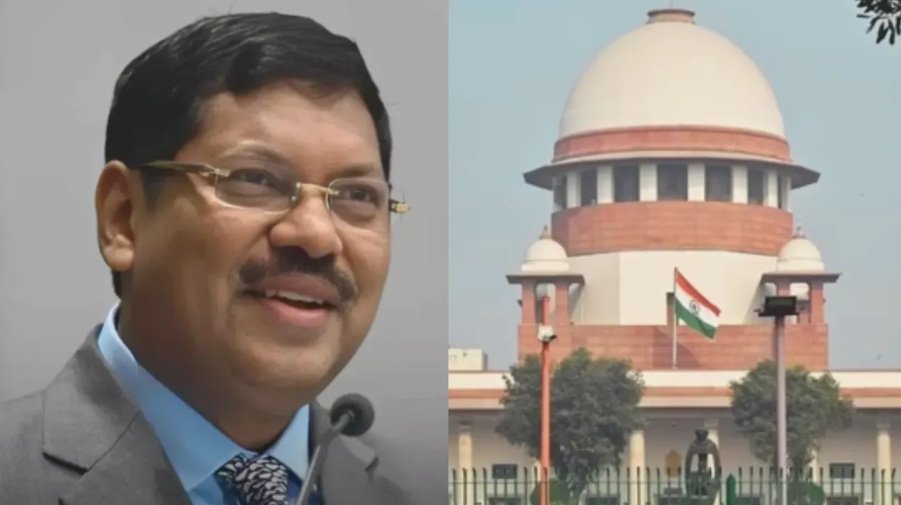
The Shoe at the Chief Justice of India

(Ramesh Kandula)
The shocking incident inside the Supreme Court on Monday — where a lawyer hurled a shoe at Chief Justice of India D.Y. Chandrachud’s successor, Justice Bhushan Ramkrishna Gavai — has left the legal fraternity and the public deeply disturbed. The act, committed by 71-year-old advocate Rakesh Kishore, occurred while the Chief Justice was presiding over a hearing.
Security personnel immediately detained Kishore, who was later released on the Chief Justice’s own instructions. Justice Gavai, unruffled by the commotion, continued with the proceedings — a gesture that reinforced his composure and dignity in the face of provocation.
The Incident and Its Spark
According to reports, Kishore shouted that “India will not tolerate any insult to Sanatan Dharma” as he flung the shoe. His outburst stemmed from a distorted perception that Justice Gavai had offended Hindu sentiments during an earlier hearing related to a petition to reinstall a Vishnu idol in the Khajuraho temple complex in Madhya Pradesh.

Those temples, maintained by the Archaeological Survey of India, are protected heritage sites where no rituals or re-consecrations are allowed. During the hearing, Justice Gavai reportedly remarked that the plea appeared to be “a publicity-oriented petition” and that “if the petitioners are so devout, they should pray to the deity rather than file cases.”
Though the comment was judicially contextual and clearly metaphorical, sections of social media seized on it, misrepresenting it as a slight against Hinduism. Despite Justice Gavai clarifying that he respected all faiths equally, outrage was whipped up online — a climate that appears to have emboldened Kishore’s reckless act.
Condemnation Across the Spectrum
The Bar Council of India, the Supreme Court Bar Association, and the Solicitor General Tushar Mehta strongly condemned the incident. Even Prime Minister Narendra Modi expressed his disapproval, calling it “an act that has shaken every Indian.”
But while the immediate condemnations were swift, the deeper issue — of religious zealotry and mob radicalisation under the veneer of devotion — cannot be ignored. Over the past decade, the political valorisation of “Sanatan Dharma” as a rallying cry has often blurred into aggression. Groups invoking Hindu protection have repeatedly taken the law into their own hands, from cow vigilantism to street-level intimidation.
Though the government distances itself from such acts, critics argue that the ideological ecosystem surrounding the Sangh Parivar has indirectly legitimised a culture of religious outrage.
The Man and His Motive
That an elderly lawyer could resort to violence inside the highest court of the land shows how deep misinformation and sectarian anger have seeped into public consciousness. Kishore’s belief that he was defending religion is a telling example of how social media-fuelled fanaticism can override both logic and law.
Yet, to claim that every such act is orchestrated by political groups – the Sangh Parivar eco-system in this case – would be simplistic. Many individuals act on personal delusion, emboldened by a climate where performative religiosity is mistaken for patriotism — and where they imagine immunity under the banner of faith.
The Caste Undercurrent
There is also speculation that Justice Gavai’s Dalit background may have contributed to the resentment that found expression in this attack. The second Dalit ever to become Chief Justice of India, Gavai has in the past faced covert discrimination. When he visited his home state of Maharashtra shortly after assuming office, senior officials failed to follow protocol in receiving him — an episode widely criticised and later rectified with an apology.
In a judiciary often seen as elitist, Gavai’s rise from a modest background stands as both a milestone and, unfortunately, a trigger for bias among a few who view authority through the lens of caste hierarchy.
A Life in Law, Above Politics
Justice B.R. Gavai comes from a family with deep political and social roots. His father, R.S. Gavai, was a respected Republican Party of India leader and a Parliamentarian who later served as Governor of Bihar, Sikkim, and Kerala. The son has carried that legacy into the judiciary, known for fairness rather than ideology.
As a Supreme Court judge, Justice Gavai upheld the abrogation of Article 370, and later stayed the conviction of Rahul Gandhi in a defamation case — rulings that reveal independence from both government and opposition pressures. His public declaration that he would not accept any government post after retirement has further enhanced his credibility.
That such a figure should be targeted in this crude manner only underscores the fragility of civility in India’s public life.
What It Reveals
Justice Gavai’s calm response — instructing the registry not to press charges and proceeding with business as usual — was an act of restraint that elevated the dignity of his office. The Bar Council has now suspended Rakesh Kishore, ensuring that professional accountability is upheld.
But the episode raises uncomfortable questions: How far has religious partisanship corroded the space for reason? How easily can social media misinformation transform a professional into a zealot? And how long before symbolic defiance replaces the respect due to institutions?
In the end, the real story is not about one man’s shoe. It is about the creeping normalisation of outrage in a democracy where faith, caste, and politics increasingly overlap — and about one Chief Justice who, even when insulted, chose composure over retaliation.
(Courtesy: substack.com)