

(Ramesh Kandula)
Freedom of expression cannot mean immunity from scrutiny when factual claims collapse
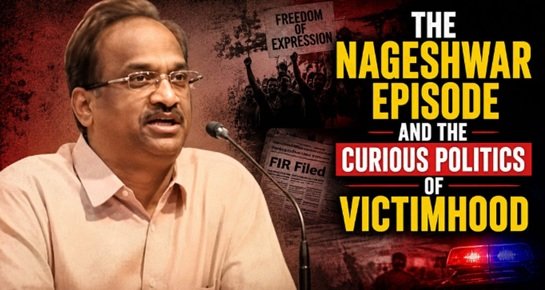
The controversy surrounding former journalism professor and political analyst K. Nageshwar began with a political claim. It soon transformed into something else entirely—a drama about impending arrest, press freedom, Telangana pride, and alleged Andhra oppression.
But stripped of emotion and political theatre, the episode leaves behind a basic question: how did a withdrawn and admittedly false claim become a story about Chandrababu Naidu suppressing freedom of expression?

The sequence of events is by now familiar.
Nageshwar claimed that Union Home Minister Amit Shah had allegedly told Pawan Kalyan and Nadendla Manohar that Chandrababu Naidu was merely an “instant friend” while Y.S. Jagan Mohan Reddy was a “long-term friend.” He further suggested that Shah had advised Pawan Kalyan not to regard Jagan as an enemy. According to Nageshwar, this allegedly emerged from discussions relating to why the Centre appeared reluctant to pursue Jagan’s CBI and ED cases aggressively.
This was no casual remark.
Such a statement carried explosive political implications.
It suggested that the BJP leadership had limited confidence in Naidu despite the TDP being a crucial partner both in Andhra Pradesh and in Parliament. It also implied that the BJP maintained a comfortable and perhaps enduring understanding with Jagan, even while supporting the TDP-Jana Sena alliance government in Andhra Pradesh.
The story had the potential to unsettle alliance politics and create confusion among Jana Sena supporters. If Pawan Kalyan, now Deputy Chief Minister in the alliance government, was indeed advised to keep channels open with Jagan, that would raise uncomfortable questions within his own political constituency.
But the story had a problem.
It lacked evidence.
Nageshwar did not claim to possess direct knowledge. He said the information came from a source who had supposedly heard it from Nadendla Manohar.
This was hearsay layered upon hearsay.
And Manohar immediately demolished the claim.
The Jana Sena leader categorically dismissed the story as concoction and fabrication and demanded that Nageshwar withdraw his remarks. There was no ambiguity and no room for interpretation.
Faced with the backlash, Nageshwar withdrew his comments.
He admitted that the information was wrong and acknowledged that he had failed to verify the facts properly.
At this point, the controversy should ordinarily have ended.
An analyst made a claim, the concerned party denied it, and the analyst himself accepted that the information was incorrect.
Instead, this is precisely where the real controversy began.
Rather than the discussion remaining focused on why such a serious allegation had been aired without verification, attention suddenly shifted toward Nageshwar himself.
He alleged trolling and hostility on social media. He complained of targeting and intimidation. Soon, sections of Hyderabad’s political and media ecosystem began projecting him not as an analyst who had withdrawn an inaccurate claim but as a victim facing political persecution.
This transformation deserves scrutiny.
Police complaints had indeed been filed in Kakinada. But these were filed by Jana Sena sympathisers who believed false narratives had been spread about their party and leadership. The Andhra Pradesh government did not register cases suo motu. The TDP did not launch legal action. Chandrababu Naidu himself said nothing.
Even Pawan Kalyan reportedly advised his supporters not to press the matter aggressively and described the comments as fictional.
Yet the atmosphere increasingly revolved around the suggestion that Andhra Pradesh authorities—particularly Naidu—were plotting revenge.
This narrative reached peak intensity on May 26 when several Telangana-based news outlets and social media platforms began circulating reports that Andhra Pradesh police were travelling to Hyderabad to arrest Nageshwar.
The reports spread quickly.
And they were false.
The Andhra Pradesh government promptly dismissed them as fake news. Home Minister V. Anitha explicitly clarified that reports of impending arrest were untrue.
One would imagine that such an official clarification would cool the situation.
Instead, the opposite happened.
The language of victimhood intensified.
Nageshwar met Telangana police authorities complaining about social media attacks. Sections of Hyderabad’s activist and commentator ecosystem began describing the issue as a freedom-of-expression crisis.
Some Left sympathisers joined the chorus. More intriguingly, even certain BJP leaders, including former national general secretary Muralidhar Rao, expressed concern.
The argument now being advanced was simple: a Telangana journalist was allegedly under threat from Andhra rulers.
This framing is where the controversy becomes genuinely revealing.
What exactly was the freedom-of-expression issue here?
No government ban had been imposed. No preventive detention had occurred. No TDP functionary had filed complaints. No police action toward arrest had been announced. The government officially denied any such move.
The original statement itself had already been withdrawn by its author as wrong.
Yet the conversation continued to revolve around impending repression.
Nageshwar, despite admitting factual error, continued to insinuate that Naidu and the Andhra Pradesh establishment were after him. In one interview, he went further and declared: “They started the war, I know how to finish it.”
This language raises obvious questions.
If the remarks were wrong and withdrawn, who exactly had started a war?
The curious feature of this episode is that the people allegedly damaged by the comments remained unusually restrained.
Nageshwar’s withdrawn story arguably hurt the TDP and Naidu more than anyone else.
It portrayed Naidu as politically expendable in the eyes of the BJP and suggested that Delhi maintained warmer long-term equations with Jagan. It also risked sowing confusion among Jana Sena supporters by implying that Pawan Kalyan had been advised to soften his stance toward Jagan.
Despite this, the TDP issued no official condemnation.
No senior TDP leader initiated legal proceedings.
Naidu remained silent.
Still, the impression persisted that Chandrababu Naidu was orchestrating persecution.
This disconnect between events and narrative is difficult to ignore.
The controversy took an even stranger turn when it acquired a regional colour.
Kalvakuntla Kavitha warned that her newly launched Telangana party would surround Naidu’s Hyderabad residence if a senior Telangana journalist were arrested. Others warned Andhra police against entering Hyderabad.
The language became unmistakably regional.
A controversy created by an unverified political claim was now framed as Telangana resisting Andhra domination.
But why?
One answer lies in the peculiar political sociology of the Telugu states.
The TDP and Chandrababu Naidu have long functioned as convenient political targets. Criticism directed at them often attracts less institutional or social risk than criticism aimed at other parties or leaders. One may disagree with this assessment, but it reflects a widely held perception.
The broader political ecosystem also matters.
Nageshwar is known to have associations with Left intellectual circles, including proximity to CPM politics. Sections of the Left remain deeply hostile toward the TDP’s present alignment with the BJP. Simultaneously, elements within Telangana’s BJP and BRS ecosystems possess their own historical grievances against Naidu and the TDP.
These overlapping interests create fertile ground for anti-TDP narratives.
But the deeper issue is not ideological.
It is regional framing.
This pattern predates the bifurcation of Andhra Pradesh and Telangana.
When commentators based in Hyderabad analyse Andhra politics, they do so as journalists and public intellectuals participating in a shared Telugu political conversation. But when criticism arises against their analysis, the dispute is often reframed as Andhra power suppressing Telangana voices.
This framing is politically potent because it converts disagreement into grievance.
An objection becomes oppression.
Criticism becomes persecution.
Fact-checking becomes censorship.
The Nageshwar controversy follows this script almost perfectly.
An analyst made a serious political claim. The claim was denied. He admitted it was wrong and inadequately verified. Complaints were filed by aggrieved supporters. No arrest occurred. The government officially denied arrest rumours.
Yet the dominant narrative became one of democratic repression.
That should concern anyone who values both press freedom and journalistic credibility.
Freedom of expression is indispensable in a democracy. Analysts and journalists must enjoy the liberty to criticise governments, question leaders, and pursue uncomfortable stories.
But freedom of expression cannot mean immunity from scrutiny when factual claims collapse.
Nor can it become a shield against accountability.
The troubling aspect of this episode is not that Nageshwar spoke.
It is that even after acknowledging factual error, sections of political and media opinion doubled down—not on defending the accuracy of the claim, but on constructing a larger mythology of victimhood and regional pride.
The controversy therefore tells us less about censorship and more about contemporary political communication.
A false claim was withdrawn.
But the narrative built around it survived.
And perhaps that, more than the original remark itself, explains why the debate refuses to end.
(Author is a Senior Journalist and political analyst)
(Courtesy: substack.com)