

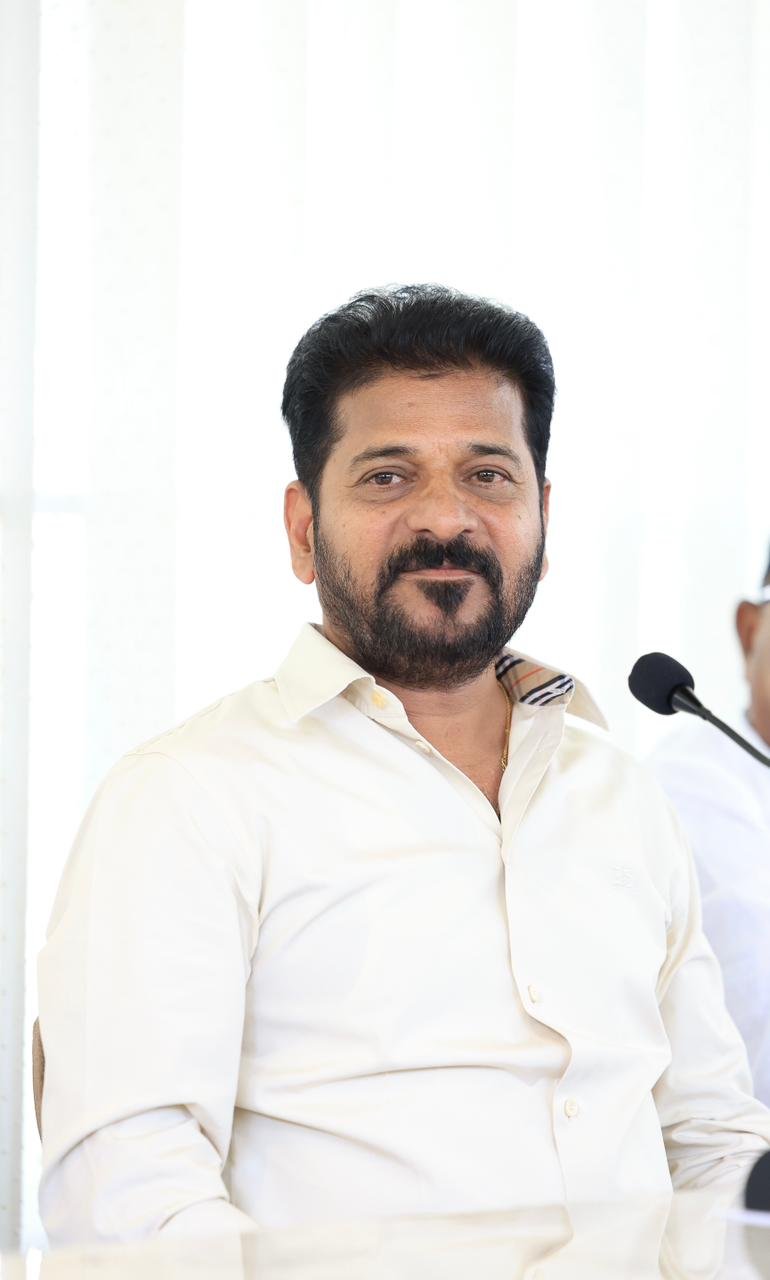
Revanth orders officials to coordinate with upper riparian states on release of water from rivers during monsoon
Hold discussions with the states to ensure the release of waters on a pro-rata basis, allocated dam-wise
Expedite the completion of the repairs of dam gates before the onset of the monsoon season
Launch an awareness programme among farmers on crop rotation and crop diversification
Complete the construction of rainwater harvesting pits/ wells in the Hyderabad city
Ensure that no difficulties arise regarding drinking water supply
CM instructs the Collectors and Superintendents of Police (SPs)to work in coordination to resolve people’s issues instantly
CM Revanth Reddy holds a review meeting on monsoon preparedness
Hyderabad, June 1: Telangana Chief Minister Revanth Reddy directed the officials to ensure that the state secures its rightful share of water from river Krishna and Godavari in view of the Meteorological Department (IMD) forecast drought-like conditions will prevail due to the impact of El Niño this year.
The Chief Minister cautioned that the state would face difficulties if the upstream states continue to adhere to the policy of releasing water only after their own dams have reached full capacity. Given the likelihood of drought-like conditions prevailing in Maharashtra and Karnataka, the Chief Minister directed Irrigation Department officials to formulate an appropriate action plan through prior consultations with officials from the states to ensure that Telangana receives its rightful share of water as per the pro-rata principle.
On Monday, the CM held a review of the monsoon preparedness of various government departments and instructed Chief Secretary Ramakrishna Rao to hold discussions with Maharashtra officials regarding a proposal wherein Telangana would utilize 100 percent of the water from the Koyna Dam (located in Maharashtra)—which is currently being used exclusively for hydroelectric power generation by that state—and, in return, supply the necessary electricity to Maharashtra.
CM Revanth Reddy noted that while thousands of TMCs of water from the Godavari flow into the sea annually, this entire flood volume occurs within a very short timeframe. Against this backdrop, the Chief Minister suggested formulating a clear policy on how to effectively divert flood waters flowing in from both the Godavari and Pranahita river systems. Furthermore, the CM directed officials of the Energy Department to prepare a report on Telangana’s rightful share of the electricity generated from the Sileru and Tungabhadra dams, which were constructed in the erstwhile united Andhra Pradesh .
During the meeting, the Chief minister inquired with officials about the maintenance of the dams and ordered to undertake the repair and maintenance of the gates of all dams across the state on a war footing. The CM recalled the challenges faced when the Kadem project received huge inflows. State Finance department officials informed the Chief Minister that Rs 300 crore had already been released for the repair and maintenance of dam gates. CM Revanth Reddy warned that strict action would be taken against officials if any issues regarding dams were to arise anywhere during this monsoon season.
The Chief Minister also directed Agriculture department officials to make decisions regarding crop cultivation based on the forecasts and reports provided by the Meteorological Department. The CM suggested that farmers be sensitized—through ‘Rythu Vedikas’ (Farmers’ Platforms)—on crop rotation, crop diversification, the cultivation of water-efficient crops, and various crop varieties.
The CM emphasized that videos created using AI technology should be screened to raise awareness on these matters and also directed officials to ensure that broadcasts related to these topics are aired on television channels. The officials were also instructed to exercise due diligence not only in crop cultivation but also in the supply of required seeds and fertilizers. The government would write a letter to the Union Government requesting that the entire quantity of urea produced at the Ramagundam factory be allocated exclusively to Telangana.
CM Revanth Reddy inquired about the details of the implementation of promises he had made during his field visits to the Kamareddy, Khammam, and Warangal districts amidst last year’s floods. The officials were ordered to submit a report on the promises, their current status, unfulfilled promises and the reasons for the delay. A disciplinary action would be initiated against any officials found to have acted negligently in the implementation of these promises.
The Chief Minister emphasized that officials must respond immediately whenever loss of life, property, or livestock occurs during the times of disaster. In the event of fatalities or property damage caused by heat waves or floods, FIRs are registered immediately to ensure that compensation reaches the affected families without delay. ₹1,000 crore are made available with the Disaster Management department . The available funds can be utilized for repairing roads damaged during floods, constructing new bridges to replace collapsed ones, and undertaking other necessary projects.
The CM also directed officials to take necessary precautionary measures to prevent the stagnation of floodwaters on roads within the limits of the three municipal corporations falling under the CURE jurisdiction during the monsoon season. The officials briefed about the progress of the works of water harvesting wells. A decision had been made to construct the wells at 141 identified locations where water tends to stagnate. Officials reported that 11 water harvesting wells have already been completed, while work on the remaining ones is currently underway. The Chief Minister directed senior IAS official Jayesh Ranjan to ensure that these works are executed on a war footing and that their progress is reviewed periodically. The CM also suggested that the three municipal commissioners and the police commissioners of the three city zones should work in close coordination to resolve issues in the city during the monsoon season.
The Civic body authorities were also directed to formulate an appropriate action plan immediately to ensure that no drinking water shortages arise in Hyderabad city or in any other part of the state even in the event of drought-like conditions. Officials informed that, as of now, there are no such difficulties.
CM Revanth Reddy further directed officials to allocate water resources for drinking purposes, power generation, irrigation, and industrial needs as per the prevailing situation. The Electricity Department should procure all necessary equipment in advance of the monsoon season and issue directives to respond immediately carrying out necessary repairs and restoring power supply whenever transformers are damaged or power lines snap, resulting in supply interruptions caused by gusty winds and heavy rains.
In the district administration, the Chief Minister directed the Collectors and SPs to hold regular meetings at scheduled intervals. The CM asserted that public grievances could be effectively resolved if Collectors and SPs work together in close coordination. The Chief Minister further emphasized that all issues would be resolved if officials from the Revenue, Police, Health & Medical, Energy, Panchayat Raj, and Urban Development departments work in tandem—not only at the state level but also at the district and mandal levels.
Rajya Sabha MP Vem Narender Reddy, DGP C.V. Anand, and senior officials from various departments—including Sandeep Kumar Sultania, Vikas Raj, Dana Kishore, T.K. Sridevi, A.V. Ranganath, Naveen Mittal, Surendra Mohan, and Christina Zongtu—participated in the review meeting. Additionally, the Commissioners of Hyderabad, Cyberabad, and Malkajgiri—R.V. Karnan, Srujana, and Vinay Krishna Reddy were present.