

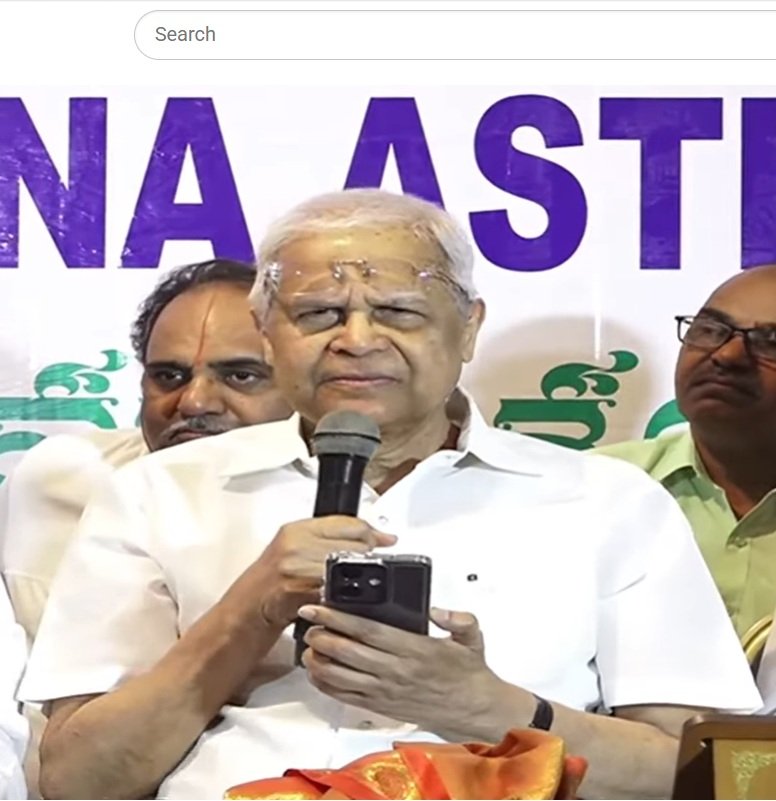
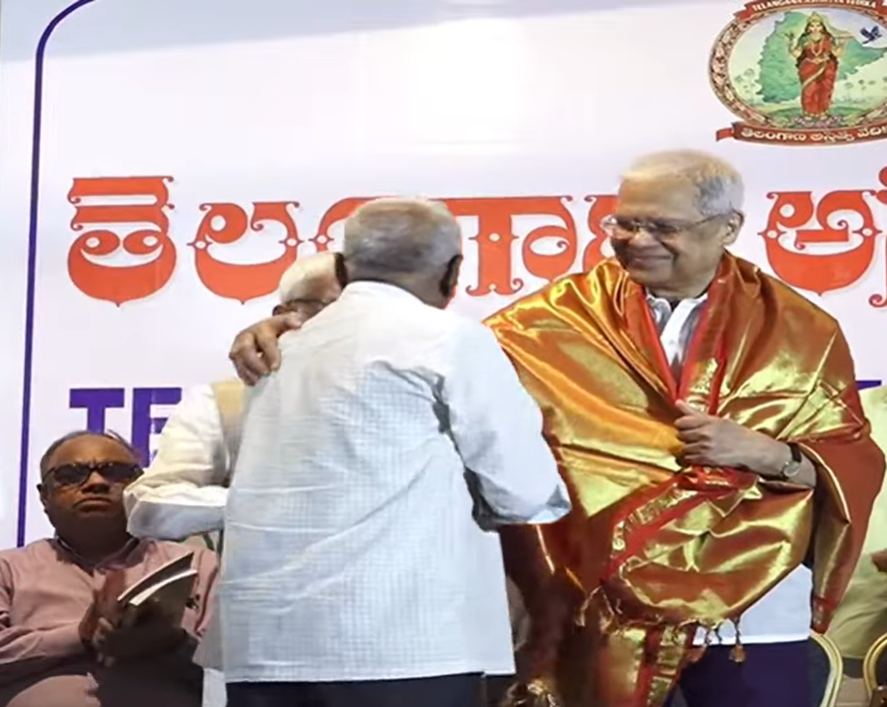
The Telangana Asthitva Vedika, which was launched on 19th of April felicitated the international Journalist S. Venkata Narayana with Lifetime Achievement award. After receiving the felicitation Venkata Narayana expressed his gratitude and views about journalism and other issues. Before going into his speech here are few words about him by the former CPRO Jwala Narasimha Rao Vanam about Venkata Narayana’s greatness.
felicitation of internationally recognized journalist S Venkat Narayan, described by the organizers as a ‘Warrior of the Word’, with a Lifetime Achievement Award. Born in Kamalapur village in Telangana, S Venkat Narayan has interviewed numerous Presidents, Prime Ministers, and global dignitaries, including Indira Gandhi and Rajiv Gandhi, and has travelled to over 90 countries. He began his journalistic career with The Times of India, later associating with The Sunday Times as a Summer Scholar and contributing as a guest writer to The Boston Globe.
He subsequently served as Executive Editor at India Today and is currently an independent journalist. It is noteworthy to mention here that, he once declined an offer to serve as Information Advisor to Prime Minister Indira Gandhi, reflecting a conscious professional choice. He is also credited with adapting psephology, the statistical study of elections and voting trends to better suit Indian conditions.
Despite his extensive experience and achievements, his response after the felicitation stood out for its clarity and restraint. His remarks reflected humility, brevity, and precision, the qualities particularly relevant in a program that also included multiple book releases and several speakers within limited time. His articulation demonstrated how one can remain concise while still being comprehensive and contextually grounded.
Now here is the text of Venkata Narayana’s speech…
‘No matter where I live, my roots remain firmly in Telangana. Distance changes location, not identity. If I speak Telugu anywhere, people instantly recognize where I belong. That connection is instinctive, not learned. This honour is not a celebration of the past. It is a reminder of continuing responsibility. Journalism today is losing discipline at a fundamental level. That decline must be addressed with urgency. Reporting must be driven by evidence and structure. Speed without verification only creates noise.’
He further observed that: ‘Psephology was introduced to bring method into electoral analysis. It was never meant to be guesswork or spectacle. Access to power has value only when it is matched with independence. Proximity should never weaken scrutiny. Indian media must return to public interest and real issues. Personality-driven narratives weaken serious journalism. Globally, credibility defines the strength of any media system. Once lost, it is extremely difficult to rebuild.’
Reflecting on his personal journey, he noted that: ‘Telangana gave me clarity in thinking and grounding in values. The world gave me scale and perspective. Mentorship is essential to sustain the profession beyond individuals. Without it, journalism loses depth over time. I accept this recognition with gratitude and clarity. It strengthens my commitment to remain relevant and rigorous.’
A close reading of these remarks highlights the importance of clarity of thought, precision in expression, and contextual relevance.
His reflections encompassed multiple dimensions, rooted identity, the instinctive bond of language, concerns over declining journalistic discipline, the structured intent of psephology, the balance between access and independence, and the critical role of mentorship. His acceptance of the honour ‘with gratitude and clarity’ reflects a composed and grounded outlook, reinforcing why the recognition is widely considered well-deserved.
(Courtesy: Jwala Narasimharao Vanam)