


(Anita Saluja)
Setting his sights on the General Election in 2029, Prime Minister Narendra Modi has stepped into election mode. A key pointer is his picking the nearly 46-year-old Nitin Nabin, who is as old as the BJP itself, to head the Saffron Party. Modi is looking to create a new record of returning to power for the fourth straight term. Nitin Nabin is set to lead the party into the General Election in 2029. He will work in tandem with Modi to prepare the party for the next parliamentary elections.
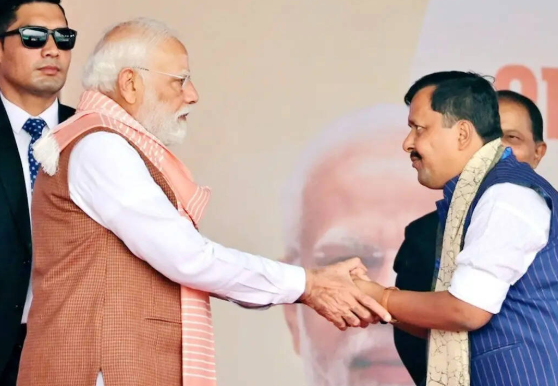
With focus on 2047, marking Centenary of the Indian Independence and the goal of making India a developed country, Viksit Bharat, Modi may opt for a far younger team, signalling generational shift in the BJP. A hands-on leader, Modi is not only leading the Government, but, at the same time, managing and shaping the ruling party.
Single-most important achievement of Modi is that not only has he made way for younger leaders in the Government, but even in the party, he has managed to shape a new team. Heavily under the shadow of the RSS, both the Government and the BJP have steadily come under his own grip.
In the Government, during his first term in 2014, veterans like L K Advani and Murli Manohar Joshi made way. Yet, Advani’s recruits like Arun Jaitley, Sushma Swaraj and Uma Bharati were Union Ministers. In 2019, they, too, faded away. Prakash Javadekar and Ravi Shankar Prasad were dropped as Union Ministers during a Cabinet reshuffle in 2021. In 2024, the likes of Smriti Irani, Anurag Thakur, Meenakshi Lekhi, General V K Singh and R K Singh were dropped.
As far as the party is concerned, Modi took command in 2013, itself, following his nomination as the BJP Prime Ministerial Candidate. Ahead of the General Election in 2014, he ensured that the then BJP President Rajnath Singh gave charge of the largest Hindi-heartland State of Uttar Pradesh to Amit Shah. Modi went on to contest and win Varanasi parliamentary constituency in Uttar Pradesh in 2014 and become the Prime Minister.
Till date, Modi continues to control the BJP organization. Things changed effectively since 2014, with Prime Minister Modi having his way in running the party organization, as well, which all along, has been the RSS turf. Soon after, he handpicked Amit Shah to be the next BJP President. It was during Amit Shah’s extended tenure that Modi retained power at the Centre in 2019. Jagat Prakash Nadda was similarly handpicked by Modi to be BJP President in January, 2020. J P Nadda was given extension till June, 2024, enabling him to lead the party during the General Election in 2024, when Modi equalled the record of winning a straight third consecutive term as Prime Minister, previously held by Pandit Jawaharlal Nehru, who won in 1952, 1957 and 1962.
Interestingly, Nadda completed his tenure as BJP President in 2023. But he kept getting record number of extensions for full three years, which is equivalent to the tenure of an elected BJP President. Reason being lack of unanimity on the choice of the new BJP President, between the RSS, the spiritual mentor of the BJP, and Prime Minister Modi. This led to the inordinate delay in decision-making. Nitin Nabin is pick of Modi that finally got the nod of the RSS. This, in itself, is seen as a record of sorts.
Earlier, RSS word was always considered final. For example, when Atal Behari Vajpayee was set to form the Government in 1998, his choice for Finance Minister was Jaswant Singh. The List of the Council of Ministers was already forwarded to the Rashtrapati Bhavan. But, the RSS did not approve of Vajpayee’s pick for Finance Minister.
Late in the night, as no one could ordinarily disturb him, RSS asked H V Seshadri to call Vajpayee. Out of sheer deference for the senior RSS leader, Vajpayee came on line. Reservations of the RSS were communicated to Vajpayee. By the break of dawn, a revised List of the Council of Ministers reached the the Rashtrapati Bhavan. Yeshwant Sinha became the Finance Minister. Such was the influence of the RSS in the BJP. Vajpayee made Jaswant Singh the Deputy Chairman of Planning Commission and later the External Affairs Minister. Clearly, things have changed now.
Modi threw his full weight behind Nitin Nabin. Describing himself as Karyakarta, Modi referred to the new BJP President as his boss. Besides, the manner in which Nitin Nabin was escorted to his new office by the galaxy of Saffron Party leadership is equally unprecedented. Led by Prime Minister Modi, former BJP Presidents like Rajnath Singh, Amit Shah, Jagat Prakash Nadda and Nitin Gadkari accompanied him.
As winds of change are sweeping across the BJP, the RSS, its spiritual mentor, it seems, cannot remain untouched. Slowly, the RSS seems to be conceding its turf, in the wholly changed political circumstances. In a reciprocal gesture, Modi has facilitated the RSS growth. RSS has now a posh office in Jhandewalan in New Delhi. RSS Chief Mohan Bhagwat security has been upgraded from Z-Plus to the Advanced Security Liaison (ASL) protocol, bringing his security cover at par with Union Home Minister Amit Shah.
There was a time when RSS always played a key role in the choice of party president. In fact, RSS Second Chief Madhav Sadashiv Golwalkar played a pivotal role in setting up Bharatiya Jan Sangh on October 21, 1951. Shyama Prasad Mookerjee was encouraged to start the Jan Sangh by lending RSS full-timers to assist him. Jan Sangh President was invariably chosen by RSS, till it was merged in the Janata Party in 1977.
Again, when Bharatiya Janata Party (BJP) was launched on April 6, 1980, the RSS continued to play a major role. When BJP patriarch L K Advani made controversial remarks about Pakistan founder Mohammad Ali Jinnah in June, 2005, Advani loyalists — M Venkaiah Naidu, Sushma Swaraj and Pramod Mahajan — reached Nagpur. The RSS sent message to Advani that he should resign as BJP President.
After prolonged negotiations, Advani sought time to remain in office till the silver-jubilee celebrations of the foundation of BJP in December, 2005, in Mumbai. Reluctantly, Advani was allowed to choose the timing, but he had to bow out of office. Rajnath Singh, from the Hindi-heartland State of Uttar Pradesh, was picked as the successor to Advani. Nitin Gadkari, too, was chosen BJP President by the RSS. Things changed from 2014, with the dawn of Modi era in the Sangh Parivar.
Modi has managed to wrest the political initiative. Now, he is fashioning the BJP into a powerful political weapon, making it difficult for the political adversaries to really face and effectively counter it. He is giving a determined push for the BJP victory at the hustings in 2029.

(Writer is Delhi-based senior journalist, political commentator and analyst. Views are personal.)