

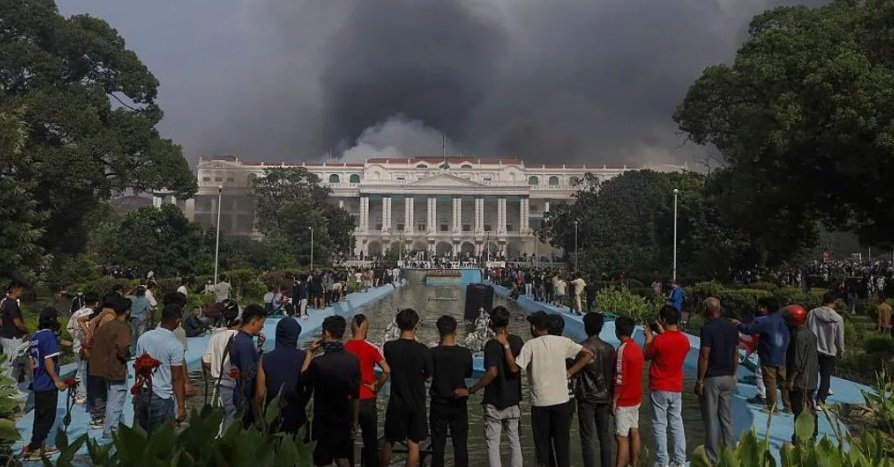
Recent developments in Nepal may keep China away from it
A golden chance to rectify the mistake committed by India in 2008
(Dr Pentapati Pullarao)
The history of Nepal and India is extremely close. So close are relations between India and Nepal throughout history that Nepal has a population of 3 crores and yet one crore Nepalese live and work in India, without visas or passports or work permits. Nepal shares an open border of nearly 1000 miles with Indian states of Uttarakhand, Uttar Pradesh and Bihar.
Till 2008, Nepal was ruled by Kings, who were great diplomats and politicians and ensured that while they were not against India. Nepalese royalty felt that Nepal should not anger China on its 1000-mile northern border.
China anyway funded rebels against the Nepalese king since 1996. Eventually, in 2008, Nepalese Kings left their throne and Nepal became a democracy. India played a major role in 2008, when sadly the Manmohan Singh government helped in removing the Nepalese King. This has had disastrous consequences for stability in Nepal and a very hostile anti- India government formed in Nepal.
India committed a major historical mistake in removing the Nepalese King. India made as major historical foreign policy mistake in 2008, when they encouraged the removal of the royal dynasty. But the democratic governments formed in 2008 all supported China and were totally hostile to India.
Why Nepal was hostile to India since 2008?
- Traditionally Nepalese rulers felt small before giant India. The King of Nepal was careful to maintain a neutral position towards India. Since 1945, there was super power rivalry between USA and Russia. Nepal was careful not to anger the USA or Russia. Nepal also kept a distance from India. But the Nepalese government was never anti-India.
- The King of Nepal also felt that India was encouraging political parties against the royalty. This also made the King be neutral towards India.
- Nepal also balanced India and China for its own safety. India should have been happy with a neutral Nepal.
Direct hostility between Nepal and India since 2008:
When the King was removed and the rebels, Maoists and other parties formed a government, they openly aligned with China. Since 2008, till the government of Nepal fell recently., they maintained hostility to India.
Such was the hostility to India that Nepal also raised border issues with India, during the height of India-China tension in 2020. Nepal created bogus issues against India, not worrying whether India will be infuriated.
The Nepalese governments from 2008 also said that they don’t want trade with India and as Nepal was a land-locked nation, they said that they will find alternate routes to the sea, through China. and did not want to use Indian ports. Nepal started developing rail and road links with China.
Symbolically, when a Nepalese prime minister was sworn in, the first courtesy call he would make was to China. It was a challenge to India. China used Nepal to harass India.
Why Nepal government fell?
Since 2008, there were 15 governments in 18 years. The governments were viewed an openly corrupt and also nepotistic. Nepalese governments performed very badly, and the Nepalese people had become fed up with their governments and were seeking ways to overthrow them.
In March 2025, the former King of Nepal toured Nepal and eh was received by huge crowds. The Nepalese people were wondering whether they did right in overthrowing royalty and got corrupt governments in return.
The conditions were ripe for over-throwing the Nepalese government. Though China gave huge sums of money, the Chinse government did not want to get involved in Nepalese politics and use their army to quell the agitators. Therefore, the crowds chased away most of the politicians . The agitation barely lasted for 36 hours and prime minister K.P. Sharma Oli and his ministers fled Nepal.
Impact of fall of Nepalese government:
- It is a major setback to China, which dominated Nepal totally since 2008 to harass India.
- It is a major gain to India, since a hostile government has been removed. We cannot guess how the future will develop. But right now, India has gained.
- There is the great possibility that the Monarchy will be restored at least partially. If that happens, there will be a neutral government in Nepal.
- The fall of the Nepalese government also shows that China will not defend its client-countries like USA does. It is a lesson to all of India’s neighbors, who try to play China against India.
- China now has a big problem in Nepal. The eliminations of its subordinated Nepalese government means that China is un-welcome in Nepal.
India must be careful in Nepal:
1, India must be careful that it should not get burdened by the new government in Nepal. India should encourage formation of a new government, which will be neutral.
2. India should reverse its mistake of encouraging the removal of Nepalese king in 2008. India should welcome the restoration of the monarchy in some form. Through centuries, the Nepalese royalty learnt the art of governance. India should not be upset at Nepalese neutrality. A neutral Nepal government is best for India, as India’s enemies will also keep quiet.
- When you look back, though at times, it seemed the Nepalese King was anti-India, in reality the King did not harm India. In fact, when India got Independence in 1947, the then Nepalese King offered to merge Nepal with India. The then prime minister Jawaharlal Nehru refused that offer. Maybe that was a big mistake.
There is no doubt the end of the corrupt Nepalese government is good for India. At least, open enemies have been removed. A neutral Nepal is best for India. If a government becomes too close to India, then India has to pay huge sums of money for that friendship. There is one less enemy on our borders now!
(Author is political analyst based in New Delhi)